Showing posts with label Kathleen Jamie. Show all posts

Thursday, 26 August 2021

Kathleen Jamie - Scotland's new makar

 I've just read that Kathleen Jamie has been named as the new makar (national poet) for Scotland. I met Kathleen a couple of years ago on a course at Ty Newydd, and afterwards I read her book of essays, Sightlines. In honour of her appointment, I'm reposting what I wrote about it afterwards.

A couple of months ago, I mentioned to a friend that I was about to go on a course on nature writing (at Ty Newydd – I wrote about it a few posts back). She chuckled, and said, “Oh, but nature writing’s so boring, isn’t it?”

I was taken aback and lost for words. Now, I would say to her: but what do you even mean by nature writing? How could it be ‘boring’ to read about something which I know she loves, just as I do? How could she not be interested in reading about what gives life to us, and makes our planet apparently unique - and how it is under profound threat?

Or perhaps I’d just give her this book by Kathleen Jamie and say, “Just give this a try. Go on – do.”

Kathleen was one of the tutors on the Ty Newydd course. I had heard of her before, but though I’d given this book to a couple of other people as a present, I hadn’t actually read it myself. I’ve just remedied this, and have found it completely engrossing – and therapeutic. It’s autumn, which is a beautiful season but has at its heart the fading of things – the fading of light, the falling of leaves, the gradual death of flowers. Of course it’s not all bad – there are birds that arrive as well as those that depart, and there are already buds on the bare branches. But still – it’s a season when it’s easy to succumb to a generalised feeling of sadness. And there are one or two things going on in the outside world which are also just a tad worrying.

So there have been mornings when I’ve woken up feeling gloomy. But as soon as I begin to read a chapter of Sightlines, I am taken into another place - and what a relief that is. That is perhaps a cliché: certainly, it’s my stock, easy answer when someone asks me what I like about reading: “A book can take you into another world…” But in this case, it really feels true. The book is a collection of essays. In most of them, Kathleen travels to Scottish islands, though there’s also one where she goes to a Norwegian museum and reflects on whale skeletons (in other essays, she writes about encounters with living whales); another where she decides she needs to see inside the body, not just outside, and examines pathogens under a microscope; another where she recalls an archaeology dig, from which the discovery of the ancient skeleton of a young girl lingers in her mind.

Wherever she goes, she is supremely attentive. She looks, she listens, she tastes, she touches, she thinks, she explores, she reflects. And she does this so effectively that the reader is right there with her, feeling the force of a wind strong enough to knock you over, seeing how gannets glint against a storm cloud, shocked at the speed with which killer whales slice through the water.

But she doesn’t simply describe what she sees. She muses, considers, makes analogies, asks questions. The reader follows not just her physical journeys, but the path her thoughts take. At the back of it all is an awareness of transience. As she says in the book’s final paragraph:

There are myths and fragments which suggest that the sea that we were flying over was once land. Once upon a time, and not so long ago, it was a forest with trees, but the sea rose and covered it over. The wind and sea. Everything else is provisional. A wing’s beat and it’s gone.

(She is flying in a helicopter as she leaves a remote, storm-swept island, where she had found a dead swan, describing its outstretched wing as a full metre of gleaming quartz-white, a white cascade: the swan’s wing, the wind, the helicopter flight – they all link into a chain of thought.)

Boring? Not by any stretch of the imagination.

Tuesday, 1 October 2019

Sightlines, by Kathleen Jamie


A couple of months ago, I mentioned to a friend that I was about to go on a course on nature writing (at Ty Newydd – I wrote about it a few posts back). She chuckled, and said, “Oh, but nature writing’s so boring, isn’t it?”

I was taken aback and lost for words. Now, I would say to her: but what do you even mean by nature writing? How could it be ‘boring’ to read about something which I know she loves, just as I do? How could she not be interested in reading about what gives life to us, and makes our planet apparently unique - and how it is under profound threat?

Or perhaps I’d just give her this book by Kathleen Jamie and say, “Just give this a try. Go on – do.”

Kathleen was one of the tutors on the Ty Newydd course. I had heard of her before, but though I’d given this book to a couple of other people as a present, I hadn’t actually read it myself. I’ve just remedied this, and have found it completely engrossing – and therapeutic. It’s autumn, which is a beautiful season but has at its heart the fading of things – the fading of light, the falling of leaves, the gradual death of flowers. Of course it’s not all bad – there are birds that arrive as well as those that depart, and there are already buds on the bare branches. But still – it’s a season when it’s easy to succumb to a generalised feeling of sadness. And there are one or two things going on in the outside world which are also just a tad worrying.

So there have been mornings when I’ve woken up feeling gloomy. But as soon as I begin to read a chapter of Sightlines, I am taken into another place - and what a relief that is. That is perhaps a cliché: certainly, it’s my stock, easy answer when someone asks me what I like about reading: “A book can take you into another world…” But in this case, it really feels true. The book is a collection of essays. In most of them, Kathleen travels to Scottish islands, though there’s also one where she goes to a Norwegian museum and reflects on whale skeletons (in other essays, she writes about encounters with living whales); another where she decides she needs to see inside the body, not just outside, and examines pathogens under a microscope; another where she recalls an archaeology dig, from which the discovery of the ancient skeleton of a young girl lingers in her mind.

Wherever she goes, she is supremely attentive. She looks, she listens, she tastes, she touches, she thinks, she explores, she reflects. And she does this so effectively that the reader is right there with her, feeling the force of a wind strong enough to knock you over, seeing how gannets glint against a storm cloud, shocked at the speed with which killer whales slice through the water.

But she doesn’t simply describe what she sees. She muses, considers, makes analogies, asks questions. The reader follows not just her physical journeys, but the path her thoughts take. At the back of it all is an awareness of transience. As she says in the book’s final paragraph:

There are myths and fragments which suggest that the sea that we were flying over was once land. Once upon a time, and not so long ago, it was a forest with trees, but the sea rose and covered it over. The wind and sea. Everything else is provisional. A wing’s beat and it’s gone.

(She is flying in a helicopter as she leaves a remote, storm-swept island, where she had found a dead swan, describing its outstretched wing as a full metre of gleaming quartz-white, a white cascade: the swan’s wing, the wind, the helicopter flight – they all link into a chain of thought.)

Boring? Not by any stretch of the imagination.

Monday, 19 August 2019

Ty Newydd


Last week, I was on a writing course in North Wales, at Ty Newydd, not far from Criccieth. People in the writing world will have heard of it; it's the Welsh equivalent of the Arvon writing centres in England, and Moniack Mhor in Scotland. The centres all provide courses with a similar structure on a variety of writing forms - script-writing, memoir, fiction, children's writing and so on. 

Ty Newydd, once the home of Lloyd George, now the Welsh Writing Centre.


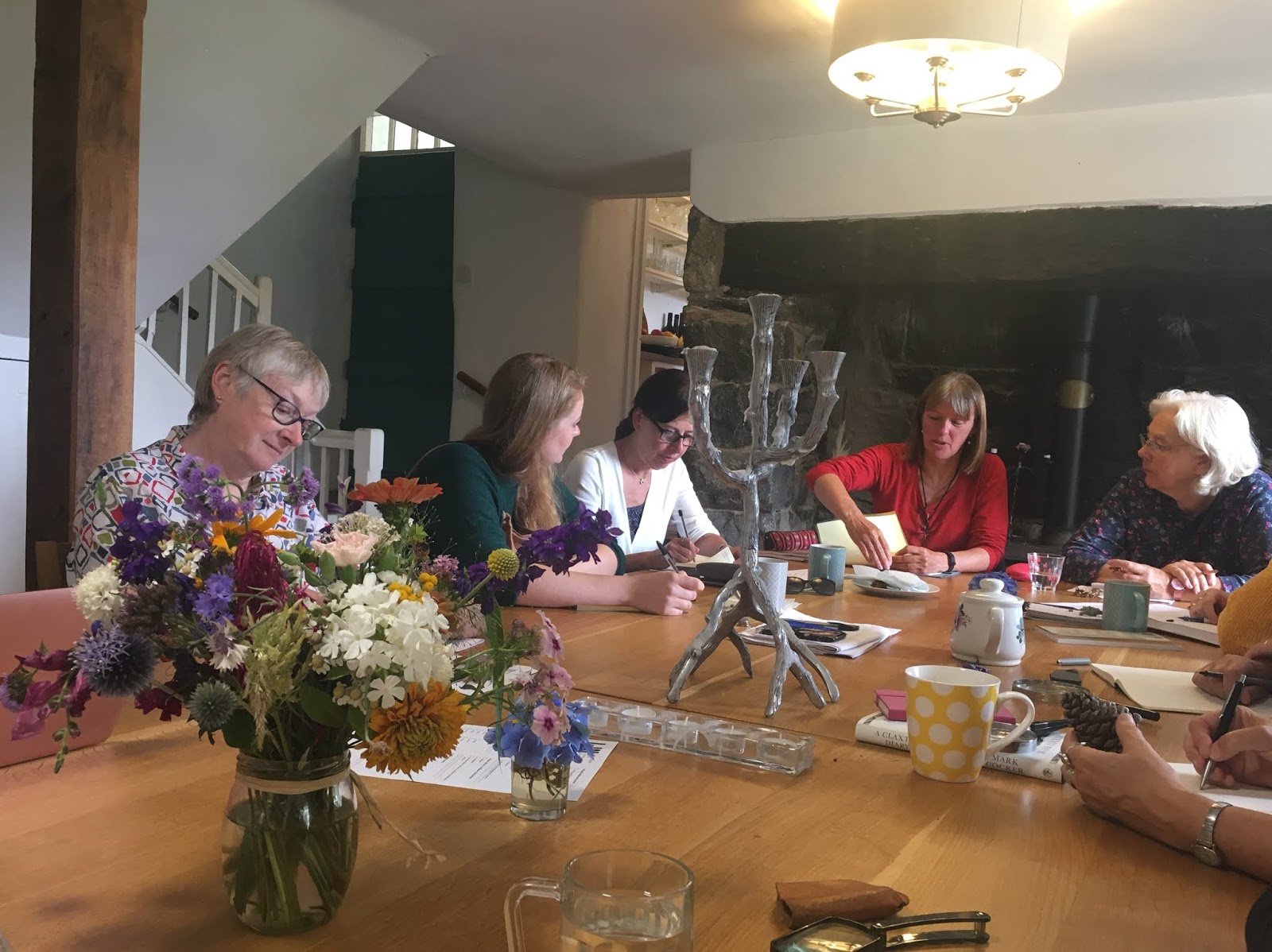
At Ty Newydd, you arrive on the Monday in time for dinner and introductions, and leave on Saturday after breakfast. There are two tutors, and often a guest speaker on Wednesday evenings: the mornings are taken up by workshops, the afternoons are free for you to write, to have one-to-one sessions with the tutors or to go for a walk down to the sea or the River Dwyfor. All meals are provided by a cook called Tony, who somehow remains completely calm while delivering a clear and entertaining commentary on what he's doing (everyone helps with clearing up and preparation one evening during the week) and producing amazing food. I was lucky enough to have a spacious room in a newly refurbished cottage; through one window trees shifted restlessly in the wind, while through the other, sheep grazed on the other side of a stone wall.

Workshop session with Mark in the garden...

...and with Kathleen inside.

Horatio Clare - a brilliant speaker - and rather a lot of feet.

The course was on nature writing, and the tutors were Scottish poet and prose writer Kathleen Jamie, and naturalist, broadcaster and writer Mark Cocker. The mid-week speaker was Horatio Clare, journalist, writer and lecturer in creative writing. (I wrote about one of his books in the post before this one.) I've probably missed out some of the things they do: they are all fizzing with talent, energy and enthusiasm for the craft of writing in a variety of different forms, and they were generous with their time, their expertise and their encouragement - Mark, incredibly knowledgeable about nature and passionate about how special and unique this planet of ours is: Kathleen, quiet, intensely focused not only on poetry, but on how writers should react to the current climate emergency. This was not about lyrical descriptions of beautiful views - though that certainly came into it: although everyone really wanted a break from politics, they were inescapable: dark shadows massing around the castle walls.

I write for children, so why, you may ask, was I on a course in nature writing? (To be fair, I think that was something the tutors wondered too, and probably some of the other participants - who were mainly poets, and it seemed to me wonderfully good ones.)

Well, I can only say that when I was browsing through the courses on offer earlier on in the summer, there was something about this one that just sounded right. It was as if a light came on, or a trumpet sounded, or a signpost appeared. I wasn't entirely certain why, but I knew that this was something I really wanted to do.

I do not have a burning desire to become a nature writer - whatever that is - or a poet. I write the occasional poem, when a thought comes to me that won't work any other way, but to be honest, my poems are more like prose that's just been chopped about a bit. But place is very important to me. My books have often been inspired and I think enriched by the landscapes in which they are set. The Willow Man is set in Bridgwater, but suffused by the atmosphere of the nearby Somerset levels; and a climactic scene takes place on - and was shaped by - Brean Down, the spur of the Mendips which juts out into the chocolatey waters of the Bristol Channel. Warrior King, about Alfred the Great, had for its birthplace Athelney, also on the levels, once the island surrounded by marshes where Alfred took shelter from the Danes - and not so very different now, over a thousand years later. I visited the places where Alfred fought - near Wayland's Smithy in Oxfordshire and above Eddington, which used to be Ethandun, in Wiltshire. In all these places, it was so easy to imagine the events that took place there so long ago: they all had in common a powerful sense of the distant past - and of something very close to magic, which also found its way into the book.


And so on. 

The river. Now how, exactly, do you convey in words what you see here?

The sea, looking towards Criccieth.

But there was something else, too. It's always good to hone your craft, whatever that craft is. And listening to the poets and the tutors focusing closely on language, on finding exactly the right word or image, was really humbling. If you get a group of children's writers together, the discussion will be fascinating. But I think it's fair to say that it will in general centre on story, voice and character, rather than on the nuts and bolts of language. Please note: I am NOT AT ALL saying that children's writers are not good writers or stylists - just that they tend to have different priorities. If you're writing for children, you need to make them want to turn the page: too much description will make them scowl, though you certainly need enough to set the scene, to create the world.

Anyway, from the exercises we did, and the way the poets and non-fiction writers talked about their craft, I gradually realised that I have sometimes been coasting: that sometimes I reach for the easy word instead of the right word, even - horrors! - for a seductively available cliché. (Though, resistant to the last, I would still tentatively suggest that sometimes the first thought and the easy word is the right one.)

It became obvious during the week and particularly during my tutorial with Mark that even when I was trying specifically to write about nature, a story or a character would come pushing its way through. Accepting this, and following up on a suggestion of Mark's, I wrote the beginning of a new story. In fact it almost wrote itself, and it's such a joy when that happens.

Hydrangeas in the garden. You can see a tiny bit of sea, if you look very hard!


On top of all that, I had the pleasure of being in a very special place with a very interesting group of writers. 
The garden was filled with bees humming among the lavender, and it was a twenty minute walk down to the sea, or a ten minute walk down to the River Dwyfor. The team who run the centre are efficient, friendly and welcoming.

Just one word of warning. If you decide to go, and the course of your choice happens to be in the summer holidays, be wary of choosing the rail line that hugs the coast and ends up at Criccieth. I did this, but when I changed at Shrewsbury and the Transport for Wales train arrived, it had only two coaches instead of the four it should have had, and people who took the train regularly said that that this kind of thing often happens. It wasn't good. In the end we switched to coaches, but there wasn't enough room for everyone. 

On the other hand, coming back was fine, and the views are lovely. But I'd think twice, if you're travelling in August, and go to Bangor instead.