Showing posts with label Mark Cocker. Show all posts

Friday, 30 October 2020

A Claxton Diary, by Mark Cocker

 If there's one thing that the lockdown reminded many of us, it's that nature is immensely important to us. For reasons that should be obvious, but also because a close relationship with nature soothes us, calms us - heals us.

I'm not suggesting you should use this book as a substitute for a walk in the woods or a spell in the garden - but it can reinforce the real thing by providing you with a regular, beautifully crafted little dose of the natural world by a writer who has observed it closely and intently for many years. To quote the book cover:

"For seventeen years as part of his daily routine the author and naturalist Mark Cocker has taken a two-mile walk to the river from his cottage on the edge of the Norfolk Broads National Park. Over the course of those 10,000 daily paces he has learnt the art of patience to observe a butterfly, bird, flower, bee deer, otter or fly and to take pleasure in all the other inhabitants of his parish no matter how seemingly insignificant."

This book contains a collection of these observations - mostly but not exclusively from Norfolk - in the form of a diary which takes us through a year's seasons. The author observes meticulously, and describes with exactitude - but he also has a huge amount of background knowledge with which to contextualise his observations.

A particular favourite of mine is the entry for 18th September 2014, and it will serve as an example. It's about swallows. He begins with a single swallow, perched on a wire. "It looks cute, but that enamel-blue bird is made of something tougher than steel. Very soon it will follow its instincts south over the English Channel, down through France and Spain and across the Straits of Gibralter. In a single non-stop odyssey it will then traverse the greatest desert on Earth."

He goes on to discuss the swallow's migratory journey in more detail, and to reflect on its symbolic resonance - the significance of its blue colour, and what that stands for in various contexts; the reason why Estonia recently chose the swallow as a national emblem; what its changing distribution tells us about climate change. But he ends with this: "We should cherish swallows for what they gift to us and for what they tell us about ourselves."

So what does this book gift to us? Well, it provides us with a few minutes of peace and focus on the natural world, in a day which at the moment is likely to feature too much dark news, too much to worry about and to fear. It shows us - or reminds us - how to look, and how each part of nature - including ourselves - is inextricably entwined in a vast and extraordinary whole.

It teaches us, perhaps, the value of stillness.

Friday, 6 September 2019

Wilding, by Isabella Tree

Wilding is an extraordinary book. It's horrifying, uplifting, a catalogue of things to despair about, a litany of things to be hopeful about. It changes the way you see the world - even well-known and much-loved landscapes. It's sobering, but also intoxicating.

It's about an ancient estate in Sussex called Knepp Castle. Charlie Burrell, the husband of the writer, Isabella Tree, had taken the estate over from his grandmother in 1987 and immediately set about modernising it: '... he began doing what every modern farmer is supposed to do: rationalise, intensify, diversify, and, if possible, spread fixed costs over a larger area.' The five tenant farms were struggling and ready to give up, so Charlie took them all back and began to amalgamate the dairies, streamline and improve farm buildings, and invest in expensive machinery. What happened next is complicated - but basically, for all sorts of reasons, it didn't work. By 1999 it was clear that the business was not viable: intensive farming, which was supposed to lead to healthy profits, was in fact resulting in huge losses. It couldn't go on.


It just so happened that in 1999, they had invited a tree expert called (appropriately) Ted Green, to come and investigate whether a 550 year-old oak tree could possibly be saved. He was optimistic, and he moved on to examine the other great oaks on the estate. He explained to the Burrells that they too were at risk - and the reason wasn't age: it was ploughing and compaction of soil due to cattle grazing. 

A tree's roots may extend two and a half times the radius of the crown, not far below the surface of the soil, where oxygen is available. But the roots are just the beginning. From the roots there extends a network of mycorrhizae - tiny filaments of fungus which take carbohydrates from the tree, but in return supply it with water and essential nutrients. It's far more complicated than that - but if this huge network is disturbed, the health of the plant, or tree, is affected. It's also affected by insecticides, herbicides and fungicides, all of which are part of the armoury of a modern farmer.

This is just one tiny piece of the jigsaw of reasons that made the Burrells decide to take a radically different approach: they would allow nature to take the lead, and see what happened. They were inspired by a Dutch ecologist, Frans Vera, who had used a similar approach on a reserve in the Netherlands called the Oostvaardersplassen. He believed in minimal intervention, in allowing natural processes to develop. This would, he thought - and actually did - result in a tremendous increase in biodiversity. It began when huge numbers of greylag geese found the marshy land, and consumed the vegetation that would otherwise have clogged up the open water. But to keep the geese coming, they needed grassland. So they introduced old, tough breeds of cattle and horses, similar to the large animals that would once have grazed the land thousands of years ago. And they left them to get on with it.

Well, it's all much more complicated than that. But perhaps you begin to get the idea. At the beginning of the book, Isabella Tree writes about turtle doves. There are now a number of pairs of turtle doves at Knepp - but almost nowhere else in Britain. The decline in numbers of this bird is far greater in the UK than anywhere else. Our population density is actually higher than that of India: there are so many of us that the pressure of any 'spare' bits of land is immense. Here in my own place, Cheddar, over the last forty years small orchards have disappeared, large gardens have been halved, fields are disappearing as we speak - because there are more of us, and we need more houses. So the wild places are disappearing, and with them, the nourishment that turtle doves, and many other species, need. 

Of course it's not all bad. There are success stories, such as the reintroduction of red kites, the increase in otters due to cleaner waterways, and so on. But overall, it's a sad story. 'In 1966, according to the RSPB, there were 40 million more birds in the UK than there are today.' There's a terrible list of declining species, but perhaps an effective indicator of the situation is that in terms of lost biodiversity, the UK is ranked twenty-ninth lowest out of 218 countries.

The book tells the story of how the 'wilding' of Knepp has led to massively increased biodiversity, and to the reappearance of masses of species of flora and fauna which have become rare elsewhere in our crowded country. It's absolutely packed with evidence and information - so much so that it's actually difficult to take it all in at one reading. One thing - it is not anti-farming. Clearly, this approach cannot be put into practice everywhere. But there is an enormous amount to be learned from it, and much that can be applied elsewhere. Even in small ways: I know now that ragwort, far from being the poisonous pest I had believed it to be, is actually an enormously valuable food source for many birds and insects during the autumn months - and is only very rarely damaging to horses and cattle. (Had I actually taken note of the evidence of my own eyes, I would have realised this; there is a great deal of ragwort on our hill, and in thirty five years, I've never once heard of any of the cattle that graze up there being made ill by it.) Towards the end of the book, Isabella Tree discusses how she envisages lots of small patches of wilderness in the UK - but joined up, connected, so that wild life has its own habitat alongside ours, instead of being gradually squeezed to the margins, and then to extinction.


Ragwort on the hill

On the nature-writing course I attended recently, and which I wrote about a couple of posts back, I was surprised to hear one of the tutors, Mark Cocker, say sadly after a walk down to the sea that he had passed fields that were little more than a desert in terms of wild life. But now I know exactly what he means. He talked also about how we, like all other living things, are part of a complex network of systems - like, perhaps, the ancient oaks with their mycorrhizae: everything is interdependent. If we lose a species of dung beetle - it matters. Yet we are losing masses of species, some we may not even have known existed.

We need to know about this stuff - and this book is a very good place to start.

Monday, 19 August 2019

Ty Newydd


Last week, I was on a writing course in North Wales, at Ty Newydd, not far from Criccieth. People in the writing world will have heard of it; it's the Welsh equivalent of the Arvon writing centres in England, and Moniack Mhor in Scotland. The centres all provide courses with a similar structure on a variety of writing forms - script-writing, memoir, fiction, children's writing and so on. 

Ty Newydd, once the home of Lloyd George, now the Welsh Writing Centre.


At Ty Newydd, you arrive on the Monday in time for dinner and introductions, and leave on Saturday after breakfast. There are two tutors, and often a guest speaker on Wednesday evenings: the mornings are taken up by workshops, the afternoons are free for you to write, to have one-to-one sessions with the tutors or to go for a walk down to the sea or the River Dwyfor. All meals are provided by a cook called Tony, who somehow remains completely calm while delivering a clear and entertaining commentary on what he's doing (everyone helps with clearing up and preparation one evening during the week) and producing amazing food. I was lucky enough to have a spacious room in a newly refurbished cottage; through one window trees shifted restlessly in the wind, while through the other, sheep grazed on the other side of a stone wall.

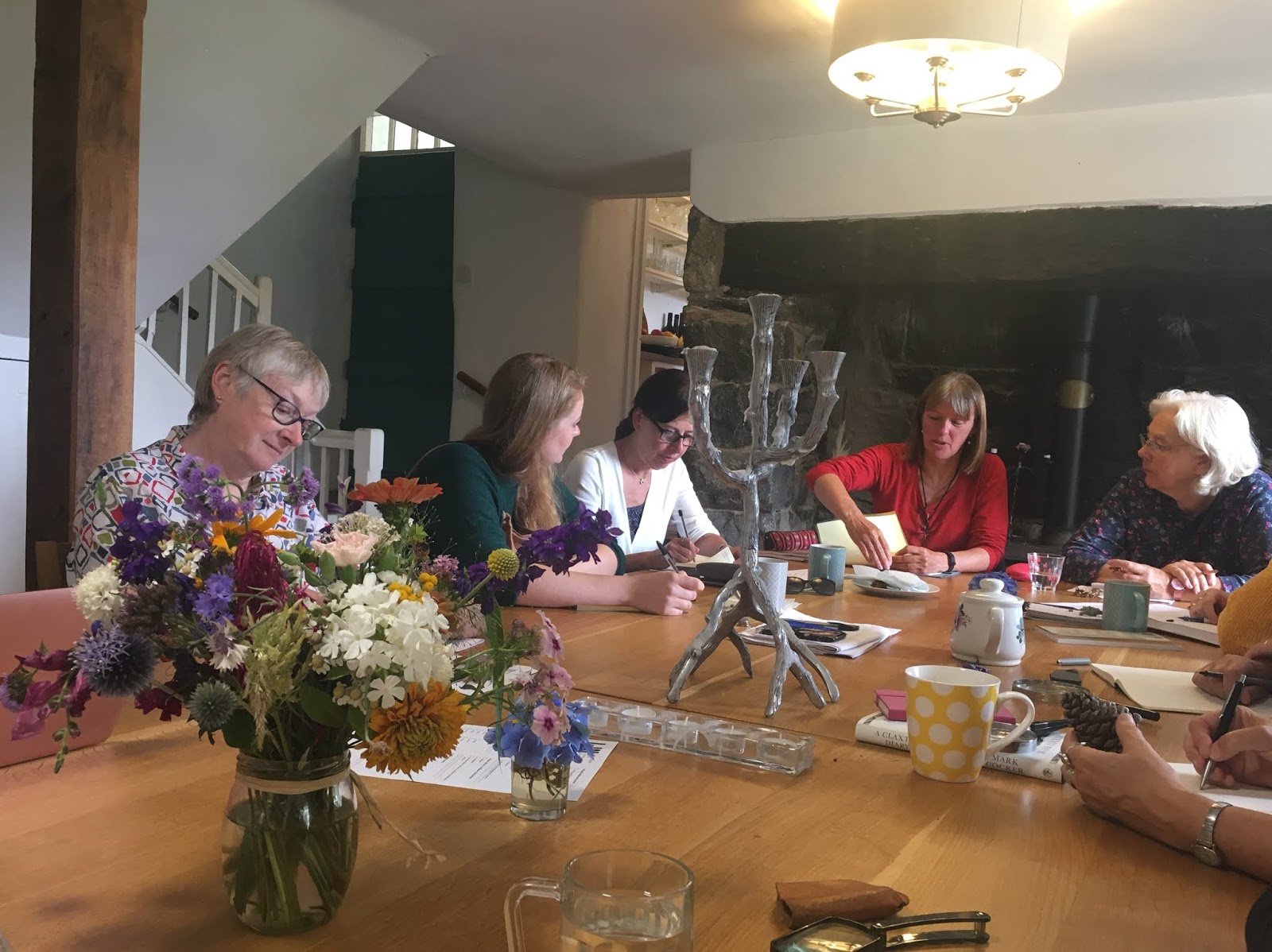
Workshop session with Mark in the garden...

...and with Kathleen inside.

Horatio Clare - a brilliant speaker - and rather a lot of feet.

The course was on nature writing, and the tutors were Scottish poet and prose writer Kathleen Jamie, and naturalist, broadcaster and writer Mark Cocker. The mid-week speaker was Horatio Clare, journalist, writer and lecturer in creative writing. (I wrote about one of his books in the post before this one.) I've probably missed out some of the things they do: they are all fizzing with talent, energy and enthusiasm for the craft of writing in a variety of different forms, and they were generous with their time, their expertise and their encouragement - Mark, incredibly knowledgeable about nature and passionate about how special and unique this planet of ours is: Kathleen, quiet, intensely focused not only on poetry, but on how writers should react to the current climate emergency. This was not about lyrical descriptions of beautiful views - though that certainly came into it: although everyone really wanted a break from politics, they were inescapable: dark shadows massing around the castle walls.

I write for children, so why, you may ask, was I on a course in nature writing? (To be fair, I think that was something the tutors wondered too, and probably some of the other participants - who were mainly poets, and it seemed to me wonderfully good ones.)

Well, I can only say that when I was browsing through the courses on offer earlier on in the summer, there was something about this one that just sounded right. It was as if a light came on, or a trumpet sounded, or a signpost appeared. I wasn't entirely certain why, but I knew that this was something I really wanted to do.

I do not have a burning desire to become a nature writer - whatever that is - or a poet. I write the occasional poem, when a thought comes to me that won't work any other way, but to be honest, my poems are more like prose that's just been chopped about a bit. But place is very important to me. My books have often been inspired and I think enriched by the landscapes in which they are set. The Willow Man is set in Bridgwater, but suffused by the atmosphere of the nearby Somerset levels; and a climactic scene takes place on - and was shaped by - Brean Down, the spur of the Mendips which juts out into the chocolatey waters of the Bristol Channel. Warrior King, about Alfred the Great, had for its birthplace Athelney, also on the levels, once the island surrounded by marshes where Alfred took shelter from the Danes - and not so very different now, over a thousand years later. I visited the places where Alfred fought - near Wayland's Smithy in Oxfordshire and above Eddington, which used to be Ethandun, in Wiltshire. In all these places, it was so easy to imagine the events that took place there so long ago: they all had in common a powerful sense of the distant past - and of something very close to magic, which also found its way into the book.


And so on. 

The river. Now how, exactly, do you convey in words what you see here?

The sea, looking towards Criccieth.

But there was something else, too. It's always good to hone your craft, whatever that craft is. And listening to the poets and the tutors focusing closely on language, on finding exactly the right word or image, was really humbling. If you get a group of children's writers together, the discussion will be fascinating. But I think it's fair to say that it will in general centre on story, voice and character, rather than on the nuts and bolts of language. Please note: I am NOT AT ALL saying that children's writers are not good writers or stylists - just that they tend to have different priorities. If you're writing for children, you need to make them want to turn the page: too much description will make them scowl, though you certainly need enough to set the scene, to create the world.

Anyway, from the exercises we did, and the way the poets and non-fiction writers talked about their craft, I gradually realised that I have sometimes been coasting: that sometimes I reach for the easy word instead of the right word, even - horrors! - for a seductively available cliché. (Though, resistant to the last, I would still tentatively suggest that sometimes the first thought and the easy word is the right one.)

It became obvious during the week and particularly during my tutorial with Mark that even when I was trying specifically to write about nature, a story or a character would come pushing its way through. Accepting this, and following up on a suggestion of Mark's, I wrote the beginning of a new story. In fact it almost wrote itself, and it's such a joy when that happens.

Hydrangeas in the garden. You can see a tiny bit of sea, if you look very hard!


On top of all that, I had the pleasure of being in a very special place with a very interesting group of writers. 
The garden was filled with bees humming among the lavender, and it was a twenty minute walk down to the sea, or a ten minute walk down to the River Dwyfor. The team who run the centre are efficient, friendly and welcoming.

Just one word of warning. If you decide to go, and the course of your choice happens to be in the summer holidays, be wary of choosing the rail line that hugs the coast and ends up at Criccieth. I did this, but when I changed at Shrewsbury and the Transport for Wales train arrived, it had only two coaches instead of the four it should have had, and people who took the train regularly said that that this kind of thing often happens. It wasn't good. In the end we switched to coaches, but there wasn't enough room for everyone. 

On the other hand, coming back was fine, and the views are lovely. But I'd think twice, if you're travelling in August, and go to Bangor instead.