Wednesday, 25 February 2015

Two junior novels

Just a word first about that term, junior novels. They're sometimes called 'middle-grade' novels, and they are - very approximately - intended for 9-12 year olds. (Many of them could be, and are, enjoyed equally by adults - don't dismiss books because they happen to be on the children's shelves in the bookshop! And 'Young Adult' books even more so...)

And an apology - I know many of the readers of this blog are in the US, and not all the books I write about are published there as yet. All I can say is, I'm sorry - and if you like the sound of a book, make a noise about it - you never know, someone might listen and publish it over there! (Fairy-tales do sometimes come true - don't they...?)

And now on with this week's books.


The Brockenspectre, by Linda Newbery.

I opened this blog with Linda's first adult book, A Quarter Past Two on a Wednesday Afternoon: she has previously written books for teenagers and another book for this age group, Lob, which is a great favourite of mine - it's a sort of re-imagining of what the mythical figure of the Green Man might be like if he lived in our time.


An illustration from The Brockenspectre


This book is a very satisfying little hardback with beautiful pictures by Pam Smy. It's set in Heidi country, in the Alps, some little time ago - there's little evidence of technology. (Such as mobile phones, those great plot-wreckers: how many good plot ideas are lost these days because all the heroine needs to do to get out of danger is make a quick call?) It's about Tomas Rust, and his father Niklas, a mountain guide. Niklas loves the mountains so much that he's often away - he almost misses his daughter's birthday - but Tomas idolises him and longs to be just as brave and fearless. But Tomas is afraid - particularly of the Brockenspectre, which, according to his father's stories, is a giant ghostly figure that lives in the mountains, waiting to trap unwary climbers.

There comes a day when his father doesn't return home, and eventually Tomas decides that he must conquer his fears and go into the mountains to search for him. But it turns out that there are things he must learn to cope with which are at the same time more ordinary, and far worse than the Brockenspectre...

The book has a terrific sense of place, and, like Lob, it has a slightly mythic quality to it - a hint of the central European fairy tale, with its forests, its quests, its children in danger. But it's also about relationships and families and learning to accept unwelcome truths. It's a powerful story, and Tomas is a main character who becomes the hero we want him to be.


The Shiver Stone, by Sharon Tregenza

The Shiver Stone is a mystery/adventure story set in 'Carreg', on the Pembrokeshire coast. The book has a distinctive, brilliantly coloured cover by Lizzie Spikes which puts the sea right where it is in this atmospheric novel - in the foreground: while the eponymous Shiver Stone looms over the whole scene. Carys lives in the village with her father. Her mother is dead, and there is a new partner on the scene, Linette, whom Carys is not very happy about.

The train of events begins when Carys makes a video of a sculptor, Tristan, who has been secretly making structures from rocks and pebbles on the beach. The video is shown on television, and this leads to the re-emergence for Tristan of secrets he'd hoped would stay buried.

It also brings a new friend for Carys, Jago: and it puts both children, and Jago's mother, into considerable danger.

This is an adventure story which moves along at a cracking pace, enhanced by the beautifully realised setting.


Monday, 16 February 2015

The Willow Man

(Sorry - the free offer has ended now - but it's still very cheap!)

Monday night at the moment is Broadchurch night at Purkiss Towers. (For those of you based outside the UK, Broadchurch is the story of a murder and its repercussions on the small seaside town where it is set. The first series was a huge success, and may well have been shown abroad already. The second one is on in the UK at the moment.)

One of the many pleasures of Broadchurch for me is spotting the settings: it was filmed on the gorgeous Dorset coast, in Clevedon, on the North Somerset coast, and at Exeter University, where I work one day a week.

But even more exciting than this has been a walk-on part for the Willow Man This is an extraordinary 45 ft high statue beside the M5, which is the main route down to the south west. David Tennant (previously known as Dr Who), the detective in Broadchurch, has to travel north several times in the series - and the shot used to show where he is has the Willow Man in the background. It's not surprising - the statue is iconic, much as the Angel of the North is at the other end of England. When it was first erected, in 2000, it was unmissable. Now, unfortunately, it's hemmed in by new houses on one side and a massive supermarket warehouse on the other - but it's still there, one foot raised, arms outstretched, ready to take a walk across the motorway and find a more natural home - perhaps on the Somerset Levels, where waterways and lanes are lined with willow trees.


I was fascinated by it, and particularly by the contradiction inherent in its appearance. It looks so strong and powerful, it's straining to move forward - but it can't. So I used it in a story about three children who are also stuck, which, naturally, I called The Willow Man. I looked it up on Amazon just now and was delighted to find some reviews I hadn't seen before: here's one. 

Tom feels left out when his younger sister Sophie is taken ill. He turns to his friend Ash for support - but Ash has troubles of his own, both at school and at home when his long lost father reappears. Meanwhile, Sophie must re-learn how to walk, talk, and use her right hand. All three children need to find strength and a way to move on, and as they begin to help each other the giant figure of the willow man beside the motorway becomes a source of empowerment for them.

This is a gentle and moving story of family problems and friendships with some very subtle magic that feels like an extension of the children's own needs.

So - to celebrate the Willow Man's appearance on primetime national television, for one week, and one week only, my book is free to download - so please help yourselves! In the US it's available here; in the UK it's here. I hope you'll enjoy it, and I'd love to know what you think of it (especially - I've got to be honest - if you like it!)

NB New reviews coming soon - of Linda Newbery's The Brokenspectre, and Sharon Tregenza's The Shiver Stone.

Monday, 2 February 2015

Moon Bear, by Gill Lewis - and remember the Colin Cotterill books?

A couple of days ago my sister was telling me about her recent holiday in Laos. It was a cycling holiday. She and her husband generally have holidays like this, which are clearly designed to make the rest of us feel very lazy and blobby indeed.

A random picture of Laos - which certainly does look very lovely.

Anyway, she said that Laos (which also featured in Sue Perkins' recent documentary series about the Mekong) was very beautiful. I had told her about the Colin Cotterill books about a coroner/detective who tracks down criminals with the help of a very motley crew, including a centuries old shaman. I reviewed them here. Like me, my sister thoroughly enjoyed the Dr Siri books - and she found it particularly special that she was able to read them in the place where they were set. She also found out that Cotterill uses profits from the books to fund a project which pays for teachers to be trained to work in Laos, and also for books to go to children there. So all the more reason to buy his books, apart from the fact that they're such a treat that I'm really looking forward to the pleasure of re-reading them.

Funnily enough, never having known the slightest thing about Laos before coming across the Dr Siri books, I recently read another book set  there. It's called Moon Bear, and it's by Gill Lewis, whose first book, Sky Hawk, was an instant hit. She writes for children, but she is also a trained vet, and her books so far have all featured animals and raised questions about human responsibility with regard to endangered species.


Moon Bear is really not an easy read, but it's a very good one. At the centre of it is a boy called Tam, whose village is in the way of a new dam. The dam may overall be a good thing for the people of Laos - but it's certainly not good for the villagers, who have to move from their homes to a new village. At the beginning of the story, Tam has captured a moon bear cub, which he knows he can sell for a good price. When they move, all does not go well for Tam and his family, and he is forced to go to the city to earn some money by working in a place where bears are kept in appalling conditions and 'milked' for their bile, which is much prized in traditional medicine. It's horrendous in every way - but it gets even worse for Tam when a new bear cub arrives. It turns out to be the one he caught, and he becomes very attached to it.

His relationship with the bear is in many ways simpler than his relationships with other human beings. He has to decide who among his friends deserves his loyalty and his trust: who needs him most, and how he can be a good person despite his circumstances and despite the turmoil he, his family and his country are going through.

It's a complex book and often a harrowing one. Read it - but maybe then go and hang out with Dr Siri and his pals for noodles, banter, and light relief - though particularly in the later books, politics and cruelty are also present. There is humour in the Chief Coroner's world, but there are also the chilly realities of poverty and realpolitik - and those same realities drive the ordeals that Tam undergoes in Moon Bear.

Friday, 23 January 2015

Trouble on Cable Street, by Joan Lingard

Anyone who was teaching English in the late 70s/early 80s - and probably after that - will remember the name of Joan Lingard. She wrote Across the Barricades, a sort of Romeo and Juliet set in Belfast during the Troubles. Kevin is Catholic and Sadie is Protestant: they really shouldn't fall in love, but they do. It worked really well in schools: the story was gripping, it dealt with emotions deeply relevant to teenagers, and there was lots to discuss and tease out - so thank you for that, Joan Lingard!


She is still writing, and her latest book is set in the east end of London in 1936. It's an unusual combination; from Dickens on, there have been lots of books set in Victorian London featuring the lives of the working class, and there are plenty set against the background of the Blitz - but I can't think of many set in this particular time and place. Trouble on Cable Street concerns Isabella, whose mother is Spanish. She has two brothers. One has chosen to fight in the Spanish Civil War for the Republicans: the other, by contrast, is attracted by Oswald Mosley's increasingly powerful Fascist movement in London.

The story sheds an interesting light on a turbulent and not particularly well-known period. We know now that fascism in England was a dead end; but it's important to remember that they didn't know that at the time. It must have been very frightening to see the Blackshirts marching through the streets and to witness the riots and the rabble-rousing speeches, particularly if, like Isabella, your mother was a foreigner and you worked for a Jewish factory owner. Isabella senses for herself the charismatic power of fascism in the person of her brother Arthur's friend, Rupert; she distrusts him, but she sees his power - and his good looks. The people she loves are in very real danger, from several different directions. By the end, no-one is left unscarred. 

The book tells us a great deal about the political state of Europe in the years leading up to the war, and it makes us feel what it must have been like to be on the streets of London in the path of a fascist demonstration. It also resonates with the present climate, where extremists whip up hatred, immigrants provide easy scapegoats, and cities have once again been scarred by riots. But at the centre of it is Isabella, strong and warm-hearted, who must negotiate a path through the danger and uncertainty and decide, as we all must do, where to place her trust and her love.


Friday, 16 January 2015

All The Light We Cannot See: by Anthony Doerr

This is a big book – it’s one of those giant paperbacks, and it has over 500 pages. Yet Doerr uses language with the precision of a poet. To test this out, I’m going to open it at random and see what’s there. Here we go: He looks up. Suspended lamps, rows of spines fading off into dusty gold. All of Europe, and he aims to find one pebble tucked inside its folds. And again: All morning Etienne crawls along the attic floor with cable and pliers and tools her fingers do not understand, weaving himself into the center of what she imagines as an intricate electronic net.

The novel is set in France in the Second World War. Like Richard Flanagan’s Wanting, which I reviewed here a while ago, it weaves together two stories, and it’s difficult to see exactly why they will come to meet – except, of course, that here is a continent – a world – in chaos; so that unexpected juxtapositions might almost be expected to happen.

Marie-Laure LeBlanc is the subject of the first story. Blind from the age of six, at the beginning of the story she lives in Paris with her father, who works at the Museum of Natural History. He has constructed for her a model of their neighbourhood; each house, each street, each storm drain is there, so that she can learn it with her fingers and then apply her knowledge so that she can find her way about the real city. Every day, he takes her with him to the museum, and some afternoons he leaves her with Dr Geffard, ‘an aging mollusk expert whose beard smells permanently of damp wool’. He tells her about the reefs he explored as a young man, and he lets her feel the thousands of specimens he has: The murex Dr Geffard keeps on his desk can entertain her for half an hour, the hollow spines, the ridged whorls, the deep entrance; it’s a forest of spikes and caves and textures; it’s a kingdom. This knowledge becomes important to her later on; nothing is wasted in this book. When war breaks out and the Germans are about to invade Paris, Marie-Laure and her father flee, eventually taking shelter in St Malo, in the tall, narrow house where her reclusive Uncle Etienne lives, cared for by his redoubtable housekeeper, Madame Manec.

Meanwhile, a white-haired boy called Werner Pfennig (who, we learn at the very beginning of the book, will also end up in St Malo), is growing up in an orphanage in a mining town in Germany with his sister, Jutta. Werner has an agile mind and capable fingers; he and Jutta are fascinated by radios, and he teaches himself how they work and constructs his own. He dreads the thought of working in the mines which killed his father, and when his unusual skill comes to the notice of the authorities, it seems that he may have found a way out. But in the Germany of the Third Reich, his education comes at a price; he sees terrible things and he fears that he is morally compromised.

It would be unfair to say any more about what happens to the two young people – but perhaps you would like to know that, unlike Wanting, this novel ultimately offers hope: it suggests that goodness exists despite evil, and even emerges and develops as a reaction to terrible circumstances.

One of the many remarkable things about this novel to me is the way in which Doerr succeeds in recreating the detail and texture of life in mid-century France and Germany. It’s easy to take this for granted as a reader, but it really isn’t an easy thing to achieve. I’ve written some historical fiction. I did a lot of research for a book about Alfred the Great, called Warrior King, and eventually began to write. After a couple of pages, Alfred needs to have a bit of a think before he decides what to say, so he reaches out for a drink. But a drink of what? And from what? What were cups/goblets made from in the 9th century? Metal, wood? What kind of metal? It’s those little details, which you don’t even have to think about when you’re writing a contemporary novel, which trip you up so easily. So far as I noticed, Doerr doesn’t put a foot wrong. Here, for instance, he’s writing about what happens when the electricity supply in St Malo becomes erratic. Clocks run fast, lightbulbs brighten, flare and pop, and send a soft rain of glass falling into the corridors. How did he know that’s how it happens? I would have thought the electricity would just flicker. You hardly notice such details, but they all help to create a completely authentic world.

This is a remarkable novel. There’s so much in it that I know I will come back to it and re-read it, and I don’t do that often.

Just one criticism, and it’s for the publisher, not the author. Usually, I find these large format paperbacks a pleasure to read. This one looks lovely, but it's incredibly difficult to handle, because the spine is so stiff that you can’t open the book properly, let alone get it to lie flat. If publishers want to encourage readers to buy traditionally published books, they really need to do better than this.


Tuesday, 6 January 2015

A Meal in Winter and The Puppet Boy of Warsaw

One of the many nice things about Christmas is that as a family, we often give each other books for presents. Sometimes we get it wrong; there was one famous year when great minds thought far too much alike and we all ended up with the same books.

This year, two of our Christmas books deal with one of the darkest periods of recent history – the attempted extermination of the Jews in the Second World War.

How do you write about such things? Does anyone have the right to create fiction about such a terrible reality? Can the story properly be told by anyone except a survivor, or an objective academic researcher? Fictionalising the Holocaust is a very risky thing; someone will almost certainly feel that you’ve got it wrong. The Boy In The Striped Pyjamas, for instance, by John Boyne: the viewpoint is that of the young son of a concentration camp commandant. We are asked to believe that, though he lives on site, he does not understand the nature of the camp, even when he befriends a child on the other side of the wire. The book has been very successful, and I’ve spoken to many children who love it and have been moved and informed by it – but some adults find it to be an unacceptable sentimentalisation of an appalling reality.

A Meal in Winter is by a French writer, Hubert Mingarelli. It’s much shorter than the average novel, and it’s told in deceptively simple prose, with short, direct sentences. The narrator is a German soldier serving on the Eastern Front with his two friends, Emmerich and Bauer. We gather that they are one of the Special Action Groups, whose main task was to hunt out and kill Jews. Their friendship is the main factor in their ability to survive the cold, the hunger and the morally depraved nature of their duties. One day, they are told that there is to be a new group of ‘arrivals’. It’s not explicitly stated who they are – the narrator doesn’t tell us stuff that he already knows – but it’s clear that they are Jews, and that the work that their arrival will involve is shooting them.


The only way the three friends can avoid the ‘work’ is by volunteering to go out and hunt for Jewish partisans in hiding. This they do. But though they have avoided the mass killing, they know that if they return without a prisoner, they won’t be able to use the same dodge again. Emmerich’s observant eye enables him to spot a hiding place in the woods, and they find their prisoner.
Apart from a ‘flash forward’ to Emmerich’s death, the rest of the book tells the story of their journey back to camp – the meal of the title is a meal they manage to concoct in a tumbledown deserted hovel. It all happens in that one day. The events are not complicated, but the moral landscape of an ordinary person tasked with inhuman and abhorrent duties is laid bare. Here, for instance, is the narrator as he and the others are setting off on their hunt.

My own thoughts didn’t stray far. I returned to the memory of the previous night’s dream, to my tram. But already, it seemed far away. That’s just how it is with dreams. Within a week, it would have vanished into a black hole, where it would remain forever. If only we could put whatever we wanted into that black hole…

There’s nothing explicit, but there is power in that last sentence, when we relate it to our gathering understanding of where these soldiers are and what they’re doing.

The second book, The Puppet Boy of Warsaw, is by Eva Weaver – who is German, though she moved to England in 1966. It’s about a Jewish boy who, like thousands of others, was forced into the Warsaw Ghetto. Mika inherits from his grandfather a remarkable coat which contains many secrets, which help him to survive to take part in the Warsaw Uprising. (That shameful episode when the people of Warsaw rose up against the Germans, in the belief that the Russians would come to their aid. But the Russians sat on the other side of the Wistula, and waited till the Germans had crushed the Polish resistance before their tanks rolled into the ruined city.) 

This is a very different book from A Meal In Winter – more expansive and conventional in style, perhaps – but part of the territory it explores is similar: the second half of the book moves away from Mika’s story to explore what became of the German soldier who exploited but also befriended him. It asks awkward questions: can there be any kind of redemption for ordinary soldiers who were required to do appalling things? How did such men live with their memories for the rest of their lives? How did their actions, their compromises – their guilt – affect their children, the next generation? How do people – and countries – heal and reconcile when unforgivable things have been done, both to them and by them?

Hard questions, which both of these books take on with courage and artistry.


Monday, 5 January 2015

Welcome to 2015!

New post on books coming up shortly, but in the meantime, yes - 

Happy New Year! 

We were in Brussels over Christmas with family. On Saturday 27th, it snowed heavily all day. Sunday was bright, cold and clear - perfect for sledging and snowballs. So we went to a park called La Hulpe, just outside Brussels, and it was lovely. The next day, the snow was gone.


Chateau La Hulpe

And now, the decorations are down and spring is on its way. All right - it's quite a long way off yet, but the signs are there! 

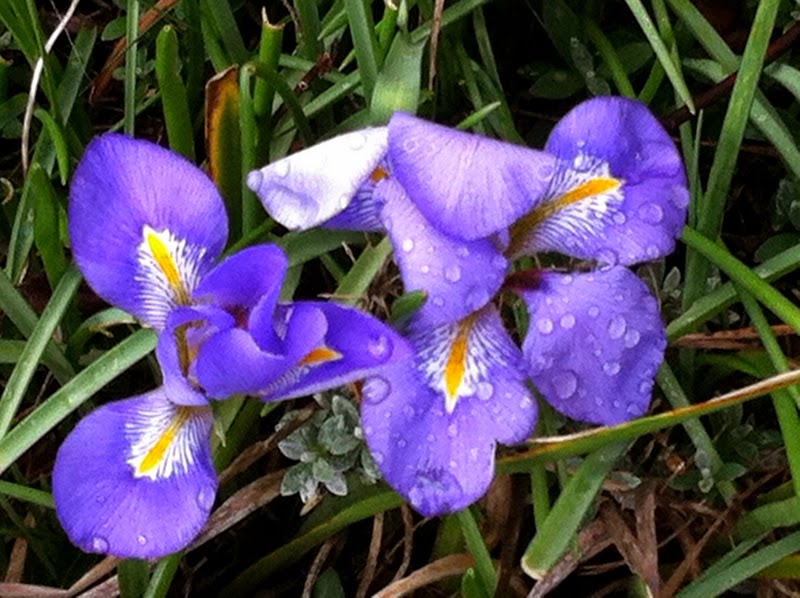
Iris Stylosa in the garden. There is one crocus, but I have to admit it's a bit bedraggled for meeting the public!

Hope you had a lovely Christmas, and that 2015 will be all that you hope for! Or, well, as much of it as possible, anyway...