Wednesday, 5 August 2020

Chanel's Riviera, by Anne de Courcy


After finishing Overstory, I felt I wanted to read something that was easier, less emotionally demanding. Non-fiction, I thought. And right on cue, up popped an offer for history books for 99p. This one appealed; I remembered seeing an intriguing film about Chanel some years ago; also, this book covers an era that's interested me for quite some time - in fact, I've written two novels set in Europe during the war years. (Don't go looking: neither has so far been published, though I live in hope. Well, you have to, don't you?) I think somewhere else on this blog I've written about Anne Sebba's Les Parisiennes, which deals with the topic of the very different ways in which French women respnded to the exigencies of war. Chanel, I knew, was one of those who found herself a handsome and very useful German lover - no mean feat as she was almost sixty.

The first part of Anne de Courcy's book  deals with the Riviera in the thirties, and it is a delicious look through the keyhole at the lives of the incredibly rich and cosmoplitan group of people who made the south of France their playground and luxurious retreat at this time. Chanel herself had a palatial house built, with no expense spared, where she entertained large house parties; guests and neighbours included Winston Churchill, Somerset Maugham, Scott and Zelda Fitzgerald, Igor Stravinsky, Serge Diaghilev, Edith Wharton - and later the Duke and Duchess of Windsor (who do NOT come across well). So, you know, just the kinds of people you and I have to tea all the time.

Chanel came from a childhood of extreme poverty. When she was twelve, her mother died, and her father abandonned her, leaving her in the care of nuns in a convent, where she was pretty much confined for seven years. (Apparently she later gave differing accounts of her early years, but this much seems to be undisputed.) She then, by virtue of becoming the lover of various wealthy men, opened a milliner's shop, which later became a fashion house; but her main fortune came from the famous perfume, Chanel No. 5 - though it continued to rankle with her for many years that she ad given away too large a percentage to the developers of her perfume, the Wertheimers. She must have been very, very rich: she bought houses for her brothers and supported various people, quite apart from spending money on herself. She had a large collection of jewellery - ropes of pearls of all different sizes: diamond cuffs and bracelets, ruby thises and emerald and sapphire thats. She had, naturally, a large staff, and an apartment in Paris: when she gave that up, she made do with a small flat above her atelier and an apartment at the Ritz.

She was very loyal to her friends, and was seldom without a lover or two. She was capable of great generosity, but also of casual cruelty: she closed her fashion house at the beginning of the war (having paid her staff low wages) without notice, thus depriving her workers of an income just at a time when they would have most needed it. She was anti semitic in general terms, yet she could go out on a limb to try to rescue Jewish friends who had been arrested by the Nazis - by calling on her German lover and associates.

All of this comes in the second part of the book, which deals with the German occupation of France. The contrast is great. The wealthy elite seem to have been so preoccupied with living their gilded lives that most of them simply did not notice what was happening in other parts of Europe - or if they did, they simply shrugged their shoulders, downed another glass of champagne, and assumed that none of it could possibly affect them. The Duke of Windsor, after various people had gone to a lot of trouble to organise a ship to take him to England and safety, refused to come unless the royal family issued a personal invitation, and a promise that he would be fiven all kinds of special attentions. This wasn't forthcoming, so he refused to go - eventually condescending to agree to be driven though Spain to Portugal, with, of course, vast amounts of luggage - while the roads of France were choked with refugees who had fled with only what they could carry.

Anne de Courcy reveals how life was under the occupation for a range of individuals: how things became harder and harder as the Germans commandeered most of the food and imposed increasingly cruel restrictions. She also makes it clear that the appalling treatment of the Jews in the unoccupied zone was largely undertaken by French, not German politicians and police: and she deals with the difficult period after the war, when collaborators were punished - pointing out that almost everyone, to some degree or another, had to collaborate in order to live.

It's very much a book of two halves, both of which are fascinating.

Wednesday, 29 July 2020

The Overstory, by Richard Powers

I hardly know where to start with this book, which I've just finished. It is quite extraordinary.

It's about trees. It's a novel, but it covers some of the same ground as non-fiction books such as The Hidden Lives of Trees and Wilding (see review of the latter here): namely, recent research has shown that trees are far more conscious beings than we ever dreamed of: that they communicate; that they defend themselves, that they are hosts to vast numbers of other organisms; that even in death, if they are allowed to lie where they fall, they will host more life - not just regrowth, but quantities of animals and insects and other froms of plant life. So when you knock down an ancient woodland (supporters of HS2 please note), you are destroying a whole eco-system which has been developing for hundreds of years - and which will take hundreds of years to replicate. Planting new trees doesn't do the job, though it's better than nothing. And that's not to mention what trees do in terms of soaking up carbon dioxide.

Like Wilding, Overstory makes you adjust the way you see life on our planet and our place within that incredibly complex network of systems. For so long, we have seen ourselves as separate and superior to nature. We've plundered the earth for what we want, and while we didn't want too much, that was okay. But now, we want more and more, and we take more and more, and the planet can't cope. We have to see and understand this if we want life to continue to exist on our beautiful, once-in-a-universe planet - or at least, if we want human life to continue. We are part of nature; we aren't separate. If we destroy forests, we destroy our own future.

Trees at Tyntesfield, in Somerset, UK


So how do you tell that story in a novel? Well, this is how Richard Powers does it. The book is set in America. It features nine individuals, beginning with a fairly brief history of each of their lives. (The book is very long, so he has plenty of time.) He is very good at this. Each character is very real, very complex; each is smart in different ways. So for instance, the first story concerns a family descended from a Norwegian immigrant who moves out west, bringing with him some seeds from an American chestnut tree. Most of them don't survive, but one does, and grows into a vast and beautiful specimen which exercises a strange fascination over the Hoel family. Partly this is because a disease has killed off most of these trees: the Hoel tree has so far survived because it is so far west - but the disease spreads inexorably, as these diseases do.

Each year one Hoel after another takes a photograph of the tree. Eventually, the last descendant, Nick, creates art installations around the tree, and becomes more and more passionate about trees. Eventually, he meets up with the other eight, who by very different paths have also become desperately concerned about the way big business is destroying woodlands that existed long before white people colonised America: in the end, they take drastic measures which have a huge effect on all of their lives.

I can't pretend I understood everything in the book. In particular, there is a character called Neelay who creates virtual reality games. I have never played computer games, so I don't understand the simplest things about them - and this story line becomes very complex indeed.

But even so, I found it absolutely compelling. Here is a sample of the writing. The character is Patricia Westerford, a scientist and academic who lives in a hut in a forest.

The trees are busy tonight, fixing carbon in their dark phase. All will be in flower before long: huckleberry and currant, showy milkweed, tall Oregon grape, yarrow and checkermallow. She marvels again at how the planet's supreme intelligence could discover calculus and the universal laws of gravitation before anyone knew what a flower was for

The book is an astonishing achievement. Heart-breaking and inspirational in equal measure.

Sunday, 19 July 2020

The Water's Daughter, by Michelle Lovric

Michelle Lovric writes fiction for adults and children: a common theme of all her novels is a Venetian setting, and it's very clear from a reading of any of her books that she knows Venice very well, and loves it very much - I think it could certainly be argued that Venice is absolutely at the heart of her writing. She also writes non-fiction; most recently she collaborated with Gemma Dowler on a book about her mudered sister, Millie Dowling, which topped the Amazon and Times bestseller charts. She's also compiled numerous anthologies.

(Image taken from Michelle Lovic's website.)


This book, which is for children, follows on from several others set 
in the past, and in a parallel Venice . Geographically it's remarkably similar to the city we know today, but it also features a whole troupe of magical creatures. I was particularly delighted to meet the mermaids again: charming, beautiful, but very down-to-earth (!) creatures who live underneath the city and are distinctly foul-mouthed, owing to the fact that they learned their language from pirates. But new to this book is a whole palazzo full of magical creatures who have been transported (by mistake) from Arabia - including a beautiful and utterly amoral djinniya, who has great powers - which, fortunately for Venice, she is not very competent at handling. 


Its human heroine is 12 year old Aurelia Bon, the child of appalling parents who at the beginning of the book are planning to force her to marry the unpleasant son of an unpleasant family; her only other option is to be immured in a nunnery. Aurelia is not the kind of girl to put up with this sort of treatment - she has an extraordinary gift (when she touches a building, her fingers sense its history) and with this, and with a naturally strong personality, comes a firm sense of her own importance. She runs away, and encounters all sorts of dangers but also all manner of wonders. 

She has to battle against all sorts of enemies: a jealous historian who envies her ability to pull the crowds, and has designs on her magical fingers; her ghastly suitor and his family; the very creepy priest in charge of the nunnery; a bunch of pirates (who have lots of saving graces); a group of venal politicians/businessmen whose aim is to such Venice dry of her wealth; and the djinniya. The tussle between the latter and Aurelia is positively epic: they're both powerful, both very selfish, and both actually rather likeable - more so as the book goes on and they have to face up to some uncomfortable truths about themselves.

The book is a glorious flight of imagination, with excitement, humour and glamour in shed loads. I would put it at the upper end of middle-grade - particularly near the beginning, there are some quite scary bits, which might be a bit challenging for younger children - but for the right reader, it offers a gorgeously rich reading experience. And there are the other Venetian children's novels to move on to - it's not essential to read them in sequence.

Saturday, 4 July 2020

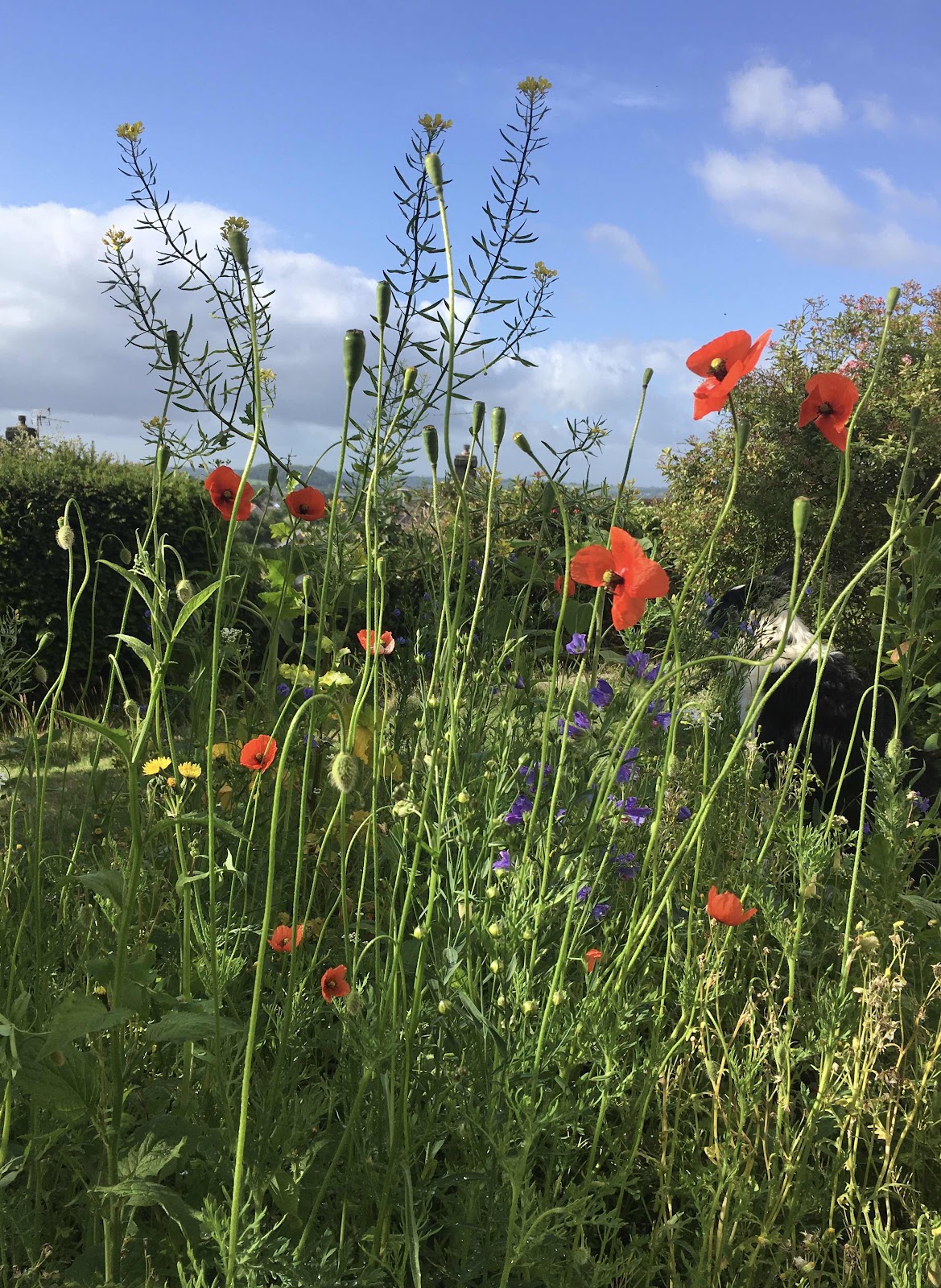
In honour of National Meadows Day!

We have experimented this year with a mini-meadow in our front garden, and it’s giving us - and, I hope, lots of insects - a great deal of pleasure. So, as it’s National Meadow Day, I thought I would share a few pictures!


Monday, 29 June 2020

The Jackson Lamb series, by Mick Herron

There have been positive outcomes of the lockdown brought about by the pandemic, and one of them (if you're a book enthusiast, as I clearly am), has been the amount of material generously put on line by book festivals and other providers. I've seen all sorts of interesting talks which should have taken place at book festivals I would never have gone to (but may well in the future); and I've also seen a few given by eminent authors who belong to the Society of Authors (which is a sort of writers' trade union).

One of these was given by Philip Pullman, writer of Northern Lights and great champion of authors' rights. I've heard him speak a couple of times, the first time in a bookshop in Bath over twenty years ago. He didn't seem to have changed all that much, and was just as interesting to listen to. 

The interview took place over Zoom, with Pullman in his study, telling us about his working habits and about some of the things he keeps around him. At one point he picked up a book, and began to enthuse about its writer, Mick Herron, saying how marvellous he was and how he always looked forward to his next book. I remembered this not long afterwards when I was in search of something - preferably a series - to read, which would take me out of lockdown life and into some other place - I didn't particularly mind which place, so long as the story was gripping and well told. If you've had a wander through this blog, you will know that I like detective/crime series: this is in that neck of the woods, but it concerns spies.

And what a curious bunch of spies they are. They inhabit a crumbling, unsavoury office block in London called Slough House, where every room seems to have an unpleasant stain somewhere - either on the carpet or on the wall - which is what's left over from some kind of incident involving the splettering of bodily fluids. These are failed spies - rejects from the department's more glamorous headquarters in Regent's Park. Sometimes they have been ejected because they've made a spectacular mess-up, like leaving secret files on the tube, sometimes because of a car-crash in their personal life - alcoholism, for instance, or gambling. Sometimes they're there simply because they got in someone else's way - someone, for instance, like Second Desk (sort of second-in-command) Diana Taverner, who is completely ruthless and entirely without any moral sense: or like Peter Judd, a politician with scruffy blonde hair and a bicycle, who hides his - well, yes, ruthlessness and lack of any moral sense - behind the facade of a bumbling would-be comedian.
The expectation is that the slow horses ( a play on Slough House - geddit?) will eventually get fed up of the mindless and pointless admin tasks they are given to do, and resign, thus saving MI5 the expense of a redundacy package or similar payoff. But the slow horses all quietly dream of redeeming themselves, and returning once more to the Park, so they keep on keeping on, despite the mind-numbing boredom and the creeping despair.

The person at the apex of Slough House is Jackson Lamb. Lamb is a relic of the Cold War: he shares the DNA of George Smiley, but also of Warren Clarke's perpetually disgusted detective, Dalziel. He is flatulent and foul-mouthed, cruelly sarcastic - and very funny. He's also very effective. When the point is reached - as it always is - where everything has gone horribly wrong and it looks as if the end is nigh for one or all of his failed spooks, Lamb is suddenly silently there, just in time to provide a solution and prove to the corrupt bosses at MI5 that they underestimate him at their peril.

Of course, if all the slow horses did was to push paper across a desk, the stories would lack a certain something. But somehow or other, they always seem to become involved in a live case: like a group of ragged Don Quixotes, they're always galloping to someone's rescue - and into danger and jeopardy.

I agree absolutely with Philip Pullman, and with all the bodies which have awarded him numerous prizes and awards. Mick Herron is not only a brillant storyteller: he's also a terrific writer. There are echoes of John Le Carre, but also, particularly in certain passages which dwell lovingly on the utter decrepitude and hopelessness of Slough House, of Charles Dickens. And he's also very funny. I particularly cherish a character called Roddy Ho, a computer geek, who has absolutely no clue as to how awful he is as a human being. And Shirley, small, fierce, foul-mouthed, but incredibly brave.

There are six in the series so far. The first is called Slow Horses, and you really should read them in sequence. But just a word of warning; if you're looking for something to make you feel positive about the state of the nation, this series is not it. If, on the other hand, you're after glorious characterisation, twisty plots and sharply ironic writing, you have a treat in store.

PS - The interface where posts are written has just been redesigned - and as a result I've just discovered a whole stack of comments awaiting moderation which I didn't know about. Quite a few were spam, but by no means all. So if you've noticed that your comment hasn't appeared - my apologies! And thanks for comments that went unacknowledged.

Friday, 19 June 2020

Chatting to General de Gaulle

As you will probably have seen on the news, President Macron recently visited London to celebrate the anniversary of Charles de Gaulle's famous broadcast from Britain at the beginning of the Second World War, in which he called on the French to continue to resist the occupying army.

This reminded me of a story told by Phyllis Goddard - a wonderful lady, now in her late nineties, who used to come to the writing group I run in Cheddar until she became too frail to do so. Phyllis has lived for many years in Cheddar, but she's from London, and she wrote many pieces about her memories of her life there before, during, and after the war.

One that had us all on the edges of our seats when she first read it was the story of her encounter with General de Gaulle. It happened like this.

Inside the Royal Empire Society - now the Royal Commonwealth Society

When she left school at sixteen, Phyllis's first job was at the Royal Empire Society in the West End. Phyllis was from the East End, and at first she was awestruck by her new surroundings, but she soon settled in. The R.E.S. was a club where members could come and stay, or just drop in. Visitors, particularly those from abroad, would often use it as a forwarding address for their mail, and to begin with, Phyllis worked in the office where this mail was sorted and forwarded or stored. But after the bombing began, there were staff shortages, and she was often called on to be the duty receptionist.

One evening, she noticed two officers sitting talking. She couldn't quite work out where they were from, as they weren't wearing their caps. But one of them, who was particularly noticeable for his great height, came over to the desk with a query, and she realised from his accent that he was not British.

He got chatting to Phyllis, asking her about her family, how old you had to be to be called up, whether women were also conscripted, and so on. The next evening, she received a note from the hall porter, saying that the two men were not to be charged for their visit: the bill was to be sent to accounts. That was unusual, and she was intrigued.

Later that evening, the two men left, but before they did, the tall one came over to see Phyllis. He thanked her for chatting to him the previous evening - perhaps their conversation had provided him with a brief respite from weightier matters? - and gave her a brown envelope. This is how Phyllis described what happened next.

I opened the envelope and inside was a small card and a very nice cream coloured scarf, edged with the blue, white and red colours of the newly formed Free French organisation. I picked up the card and read the words 'Thank you'. On the reverse side was printed 'General Charles De Gaulle'. I was lost for words!

I wondered if those two officers had sought 'sanctuary' in our lovely building and had been in the War Office during the day making arrangements to move on to where they would be safe to do their war work?

Hitler missed them though. They had left when he dropped two bombs on the R.E.S.

Later, in 1944, a 'flying bomb' destroyed our house, leaving no trace of my Free French scarf, but no bomb could destroy the memory connected with it.

The General, broadcasting his famous speech from London to the French


The whole story, along with several others by Phyllis, was published in the first anthology of work by our writing group, Through The Barn Door. This book was intended for families and friends; it is still available, but at quite a price! (Click here.)


Two more recent anthologies, Just Write, and Encounters With War, are available from Amazon at a VERY reasonable price. Profits from both go to the Cheddar Youth Trust.


Tuesday, 28 April 2020

Blood & Sugar, by Laura Shepherd Robinson

The lockdown ought to be a really good opportunity to catch up on reading. I'm reading a lot, as I always do: but I'm finding it difficult to find books that I can really get into. Friends are saying similar things; many are retreating to books they remember from childhood, because I guess they take us back to a safer, more innocent time, and because, by definition, if they're favourites they're likely to have offered a gripping read. And a gripping read is certainly what I'm after at the moment. I'd also quite like something soothing, something that offers hope for the future. Some people are drawn towards dystopias and other novels about disasters - Camus' The Plague would be an obvious one - so that, I suppose, they can compare the fictional pandemis to the real one. I don't want to do that. I stopped reading dystopias a long time ago; pictures of a destroyed world peopled only by feral gangs have no appeal for me.

And as an aside - I do find it very heartening that in this current extraordinary situation, although there is bad news in plenty, there are also so many stories of people doing kind things, finding imaginative ways to adapt and to help others. That doesn't usual happen in fictional accounts - things usually turn very nasty very quickly.

But back to finding gripping reads. I haven't had an awful lot of luck with this lately, and have been re-reading. I went back yet again to the comfort reading I've written about elsewhere in this blog, Elly Griffiths' series about Dr Ruth Galloway. That kept me going for a while. Then I reached further back, to a novel by Howard Spring, written in 1946, There Is No Armour. There are some throw-away comments which are uncomfortable for a 21st century reader - he was of his time - but he is a skilful story teller, and he writes beautifully - as in many of his books, his subject is families and relationships, how they develop over time: usually set in Cornwall and Manchester, and rather cleverly weaving in important events of the twentieth century.


And then someone on Facebook recommended this book, Blood & Sugar. It's by Laura Shepherd Robinson, and unbelievably, it's her first book. It's set in London, mostly in Deptford, at the end of the 18th century, against the background - well, foreground really - of the slave trade and the abolitionist movement. At the beginning, the body of a man is discovered hanging from a hook on the dockside. He has been horribly tortured and he's been branded.

The man is called Thaddeus Archer. Our hero, Harry Corsham, comes into the story when Archer's sister, Amelia, comes to see him, saying that her brother is missing and appealing to him to find him. Amelia points Harry towards Deptford, and he quickly identifies the body as that of his old friend - and determines that he will find his killer.

Harry is one of those leading characters who has you hiding behind the settee as he repeatedly forces his way into danger, fearlessly asking questions and barging in where he's clearly not wanted. 'Just stop it,' you groan. 'Go home! No - don't go there! Are you crazy?' But he doesn't take any notice. On he goes, putting his livelihood and his (admittedly rather odd) marriage at risk, because he simply will not give up. He's made a promise to his dead friend, and he's determined to keep it: even more so as his enquiries bring him face to face with the horrors of slavery. The author spares us nothing here. She makes us face up to the realities of this hideous trade, through the stories of individuals as well as through the central, appalling event around which the story hinges: and though poignant details, such as the blacksmith who has openly for sale iron slave collars to fit the neck of a four year-old child. It's almost unbearable.

The characters are complex. No-one is quite how they seem when we first meet them. Layer after layer is stripped away from them as we learn what forces have shaped them, so that in the end, we feel, if not sympathy, at least some level of understanding of even the cruellest villains. The historical background is handled with great confidence and expertise. (I've just discovered that the author is the daughter of Tony Robinson, of Blackadder and Time Team fame - so I guess an interest in history is in the blood.)

And the plotting - well, I find plotting hard, so I really admire a facility with it in others. And this book is incredibly tightly plotted. It's very, very clever. I read it on Kindle, but I wish I'd had a proper copy - there were a lot of times when I needed to go back and check what was happening, and that's not easy to do with a Kindle.

It's a powerful, gripping read, and it will certainly take you far away from the lockdown. But I'd advise having a sofa handy. You know, to hide behind.